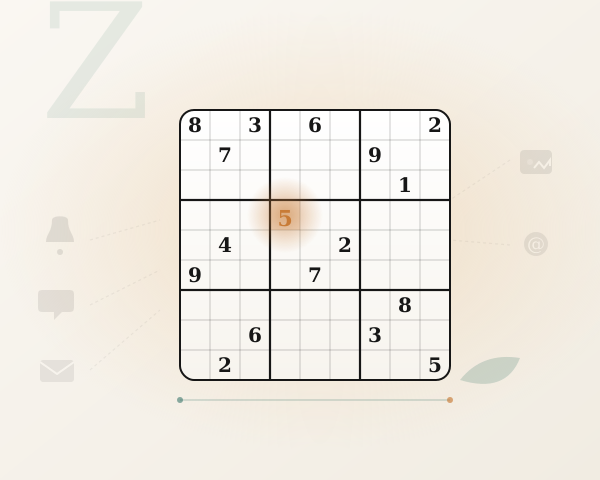
Players with ADHD describe Sudoku in a way they almost never describe other puzzles: "the only thing I can sit still for." It's not magic. Sudoku has an unusually good fit with the ADHD reward system — the feedback loop between placing a digit and seeing whether it fits is fast (sub-second), visual, and self-contained. There is no waiting, no narrative, and no social pressure. The brain gets a clean little hit of "I solved that" every few seconds, which is exactly the kind of micro-reward that sustained-attention ADHD circuits respond to.
That said: Sudoku is not a treatment. It will not replace medication, therapy, or sleep. What it does, well, is give an ADHD brain a structured way to practise focus in a low-stakes setting — five minutes a day where the only thing on the screen is the problem, no notifications, no infinite scroll, no consequence for stopping mid-puzzle. Plenty of adults with ADHD use it as a deliberate "focus warm-up" before a study or work block, the way an athlete stretches before exercise.
The single most common mistake is starting at the wrong difficulty. Easy boards finish too fast — they don't engage long enough to feel rewarding, and the ADHD brain bounces. Expert boards are too punishing on a low-energy day and reinforce a habit of quitting. The sweet spot for almost every ADHD player is Medium: long enough to feel like a real puzzle (5–10 minutes), short enough to finish in one sitting, and easy to abandon and return to without losing progress.
Zeloku has a few specific design choices that matter for ADHD players. There are no streak counters: missing a day is not punished, because streak-shame is precisely the kind of mechanic that makes a habit collapse instead of persist. There is no leaderboard. There are no ads, popups, or animated banners in the play area. The next puzzle is always the next puzzle — no "loot box", no "premium pack". When you close the tab, nothing follows you.
If you want to use Sudoku as a focus tool rather than just entertainment, the trick is to put it before the task you're avoiding, not after. A Medium board takes 5–8 minutes — about the duration of an ADHD warm-up window. Solving one before opening a difficult email, a study chapter, or a tax form noticeably reduces the activation cost of the harder task. Doing it after the task tends to turn into doing seventeen of them.
It also helps to pencil-mark generously. Holding candidate lists in your head taxes working memory, which is the exact resource ADHD brains have less of. Writing out the candidates externalises the working memory load onto the grid, which is why pencil-marks are not cheating — they're a cognitive accessibility tool. Use them liberally and without guilt.
Why it works for this audience
Sub-second feedback loop
Place a digit, see immediately whether it fits. The cadence of the reward is fast enough to hold ADHD attention without being so fast it triggers compulsion. Compare this to most apps designed to be "good for focus", which take minutes between feedback events.
No streaks, no shame
Zeloku does not count your streak. Missing a day costs nothing. There is no mechanic that punishes inconsistency — because punishing inconsistency is the fastest way to make an ADHD player abandon the habit entirely.
Quittable any time
Close the tab mid-puzzle and your state is saved. Come back tomorrow, the same puzzle is still there. No "are you sure you want to abandon?" guilt-trip, no "you'll lose your progress" pop-up.
No notifications, ever
Zeloku doesn't send push notifications. There is nothing to dismiss, nothing trying to pull you back in. You play when you choose to play.
Hint button = teaching tool
Hints explain Naked and Hidden Singles and point to the relevant cell. Advanced positions may require the separate solver or technique library.
Five minutes that counts
A Medium board takes 5–8 minutes. That's exactly the window of focus an ADHD adult often has before context-switching. The puzzle is sized to actually fit your attention budget.
A suggested routine
A practical ADHD-friendly routine: one Medium board first thing in the morning as a focus warm-up before a single hard task you've been putting off. That's it. No second puzzle. No "if you have time, do another". Doing one Medium a day for two weeks is wildly more useful than doing twelve in one Sunday and then nothing for a month. If you miss a day, just play the next day — there is no streak to break.
FAQ
Is Sudoku actually good for ADHD adults?
There is no clinical study showing Sudoku treats ADHD, and you should be wary of any source that claims otherwise. What it appears to do, based on consistent self-reports and the underlying cognitive science, is provide a low-stakes structured environment in which ADHD adults can practise sustained attention. It's a focus exercise, not a medical intervention — useful as a daily warm-up, not as a substitute for treatment.
Why do people with ADHD seem to like Sudoku?
Three reasons stack up: (1) the feedback loop between action and reward is sub-second, which suits ADHD reward circuits well; (2) the puzzle is self-contained — no narrative, no waiting, no other people; (3) it is interruptible — you can stop mid-puzzle without losing progress, so the activation cost of starting is unusually low. The combination is rare in any activity, which is why ADHD adults often single Sudoku out.
What difficulty should an ADHD adult start at?
Skip Easy unless you genuinely don't know the rules yet — Easy boards finish too fast to feel rewarding and the brain bounces. Start at Medium. If a Medium board feels too long on a low-energy day, that's a fine day to skip; don't drop to Easy as a coping mechanism, because that trains a habit of avoiding the actually-engaging level.
Should I use pencil-marks if I have ADHD?
Yes, generously. Pencil-marks externalise the working-memory load onto the grid — and working memory is exactly the cognitive resource ADHD brains have less of. Using pencil-marks is not cheating; it's a cognitive accessibility tool. The point of Sudoku is the logic, not the memorisation. Mark up every cell that has fewer than four candidates and your solve time will roughly halve.
Will Sudoku replace my ADHD medication?
No, and please do not let anyone tell you otherwise. Sudoku is a useful focus exercise — comparable in stakes to a five-minute walk or a breathing exercise. It does not produce the same effect as a stimulant medication and is not a substitute for the treatment plan your clinician has prescribed.
How do I avoid getting hyper-focused and losing two hours?
Set a single Medium board as your goal, not "a Sudoku session". A Medium takes 5–8 minutes; finish it, then close the tab. If you find yourself opening a second puzzle, that's a flag — close the laptop instead. Zeloku will deliberately not nudge you to play another.
Is Zeloku really free?
Yes. Every puzzle on Zeloku is free, no account is required to play the daily, and there are no ads in the playing area. There is no premium tier.