Learn · Variant
Killer Sudoku rules
Standard Sudoku, plus dashed-outline cages with target sums, plus the no-repeat-inside-a-cage rule. The 45 rule and the cage-sum combinations cheat-sheet are below.
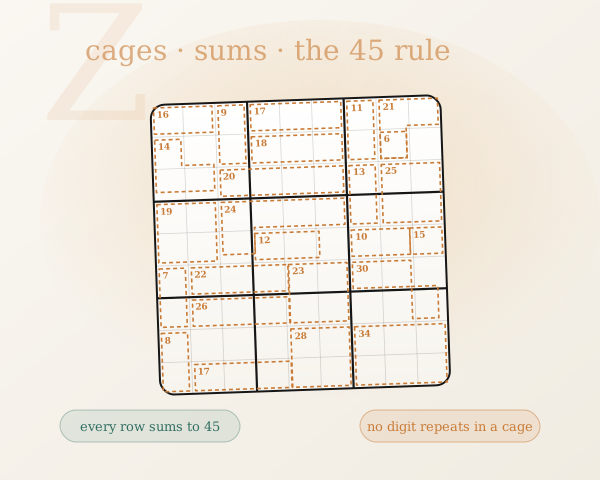
The rules in one paragraph
A Killer Sudoku is a standard 9×9 Sudoku — every row, column and 3×3 box must contain the digits 1–9 exactly once — with two extra constraints. First, cells are grouped into cages outlined by dashed borders. The small number in the top-left corner of each cage is the target sum: the cells inside the cage must add up to that number. Second, no digit may repeat inside a cage, even if the cage crosses row, column or box boundaries. Killer puzzles typically start with no given digits — only cages and sums.
The 45 rule
Because the digits 1+2+3+4+5+6+7+8+9 = 45, every complete row, column and 3×3 box on a Sudoku must sum to exactly 45. This is true on ordinary Sudoku, but it becomes a working tool on Killer Sudoku because cage sums are visible. If a row contains five cages with known sums totalling 36, the remaining cell(s) must total 45 − 36 = 9. Often that single deduction reveals the first digit on the entire board.
Innies and outies
Innie: a cell that is inside a row/column/box, with the rest of the region covered by complete cages. The innie equals 45 minus the sum of those cages.
Outie: a cage that overhangs a row/column/box by exactly one cell. The overhanging cell equals the cage sum minus 45 plus the sum of the cages fully inside the region.
Both techniques fall straight out of the 45 rule, and one of them is almost always available on the opening move of any Killer.
How to start a Killer Sudoku
- Scan for single-combination cages. A 2-cell cage summing to 3 can only be {1,2}. A 3-cell cage summing to 6 can only be {1,2,3}. A 4-cell cage summing to 30 can only be {6,7,8,9}. Pencil the candidates lightly into the cells.
- Apply the 45 rule. Look at any row/column/box where most of the cages fit cleanly inside it — the leftover cell or cells are forced.
- Hidden Singles and Naked Pairs. Once you have a few candidate sets, the standard Sudoku techniques start to bite. The rest of the solve is regular Sudoku with extra constraints.
- Watch the cage sums as you fill. If a 3-cage worth 12 already contains 9 with one cell left, that cell is 3. Free deductions appear constantly.
Cage combinations cheat-sheet
The "unique" combinations below are the ones with only one possible digit set. These are gold — every Killer Sudoku gives you a handful of them to pry the puzzle open. The high-frequency rows are the 2- and 3-cell cages; memorise them and your opening will be much faster.
| Cells | Sum | Unique combination |
|---|---|---|
| 2 | 3 | 1+2 |
| 2 | 4 | 1+3 |
| 2 | 16 | 7+9 |
| 2 | 17 | 8+9 |
| 3 | 6 | 1+2+3 |
| 3 | 7 | 1+2+4 |
| 3 | 23 | 6+8+9 |
| 3 | 24 | 7+8+9 |
| 4 | 10 | 1+2+3+4 |
| 4 | 11 | 1+2+3+5 |
| 4 | 29 | 5+7+8+9 |
| 4 | 30 | 6+7+8+9 |
| 5 | 15 | 1+2+3+4+5 |
| 5 | 35 | 5+6+7+8+9 |
| 9 | 45 | 1+2+3+4+5+6+7+8+9 (the row/column/box) |
Note: longer cages (5+ cells) have additional unique combinations at the extreme sums (15 and 35 for 5-cell; 21 and 39 for 6-cell). Outside the extremes, longer cages have multiple combinations and aren't immediately useful — but they constrain digits in nearby cages.
A worked-example opening
Imagine row 1 of a Killer Sudoku is covered by three cages: a 2-cell cage summing to 16, a 3-cell cage summing to 12, and a 4-cell cage summing to 17. Sum check: 16 + 12 + 17 = 45 — so row 1 is fully covered. The 2-cell cage summing to 16 can only be {7,9} (no repeats, no digit 8 because 8+8 repeats). The 4-cell cage summing to 17 in row 1 cannot contain 7 or 9 (those are in row 1 already, inside the {7,9} pair), so its candidates are drawn from {1,2,3,4,5,6,8} summing to 17 in four cells. That's already a strong constraint, and a single Hidden Single will usually crack the rest.
Where to play Killer Sudoku
Killer Sudoku is on Zeloku's roadmap — we'll ship a daily Killer board after a dedicated generator and difficulty model have been tested. In the meantime, the techniques on this page apply directly to any Killer puzzle from a newspaper or app. For the underlying Sudoku rules, see Sudoku rules, and for the standard techniques used in the second half of a Killer solve, see Learn Sudoku and the Hidden Single / Naked Pair walk-throughs.
FAQ
What is the 45 rule in Killer Sudoku?
Every row, every column and every 3×3 box in a Sudoku must contain the digits 1–9 exactly once. The sum of 1+2+3+…+9 is 45, so the digits in any complete row, column or box must total 45. This gives you a powerful Killer-specific deduction: if eight of the nine cells in a row are inside cages with known sums, the ninth cell is forced by subtraction. The 45 rule is the foundation of Killer Sudoku strategy.
What is a cage in Killer Sudoku?
A cage is a group of cells outlined by a dashed border. The small number in the top-left corner of the cage is the target sum — the cells inside the cage must add up to that number. Crucially, no digit may repeat inside a cage, even if the cage spans more than one row, column or box.
Can digits repeat inside a Killer Sudoku cage?
No. The no-repeat-inside-a-cage rule is in addition to the standard Sudoku rules. A 2-cell cage summing to 4 cannot be 2+2; it must be 1+3.
How do I start a Killer Sudoku puzzle?
Three steps that work on almost every Killer: (1) find any cage whose sum has only one possible combination — for example a 2-cell cage summing to 3 must be {1,2}; a 4-cell cage summing to 30 must be {6,7,8,9}. Write the candidates lightly in the cells. (2) Apply the 45 rule to any row, column or box where all cages bar one are contained inside it — the leftover cells are forced to a known sum. (3) Continue with standard Sudoku techniques (Naked Singles, Hidden Singles) on the candidates you've established.
What does "innies and outies" mean?
Innies and outies is the standard Killer Sudoku application of the 45 rule. An innie is a cell inside a row/column/box but only partially overlapped by cages — once you know all the cages that fit cleanly, the leftover cell's value is 45 minus the sum of those cages. An outie is the symmetric case: a cage that sticks out of a row/column/box by exactly one cell — the cage sum minus the part of it that fits inside the region gives the value of the outie cell. Innies and outies are responsible for most early breakthroughs on a Killer board.
Is Killer Sudoku harder than regular Sudoku?
Yes, but the difficulty is concentrated in the opening. A Killer board typically gives you no starting digits at all — only cages and sums — so the first ten minutes are heavier than a standard Sudoku. Once you have a handful of digits placed, the rest of the solve uses the same standard techniques (Hidden Single, Naked Pair, X-Wing) you'd use on a regular hard puzzle.
Do I need to know the cage combinations by heart?
No, but the table on this page is worth one careful read. The combinations for small cages (2–4 cells) come up so often that you'll memorise them within a week of solving daily. The longer ones — five cells and above — are easier to look up the first few times.
What's the difference between Killer Sudoku and standard Sudoku?
All standard Sudoku rules apply (each row, column and 3×3 box must contain 1–9 once). Killer adds two things: (a) cells are grouped into dashed-outline "cages" with target sums; (b) no digit may repeat inside a cage. Killer Sudoku puzzles also typically start with no givens, only cages — which is why opening play is so heavily about cage-sum arithmetic and the 45 rule.