Learn Sudoku
Stop guessing.
Start seeing.
A library of techniques that turn Sudoku from a hunt into a pattern game. Each page shows you when the technique applies, how to spot it on a real board, and where to practice it.
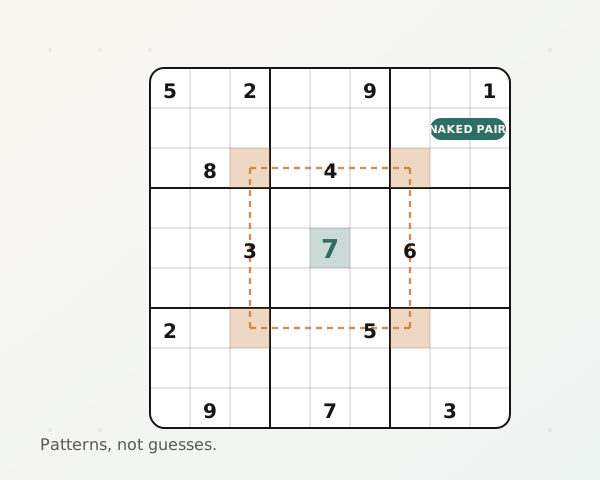
Eight techniques, four families
There are several dozen named Sudoku techniques in the wild, but eight of them cover essentially every Easy, Medium, Hard and Expert puzzle ever printed, in four pairs: Hidden Single pairs with the plain naked single as the foundation; Naked Pair pairs with its mirror image Hidden Pair; Pointing Pair pairs with its mirror Box/Line Reduction; and X-Wing pairs with its three-line big sibling Swordfish and the chain-based XY-Wing. Everything else you'll see named on forums — Jellyfish, Skyscraper, Empty Rectangle, Coloring — is a renaming, a thickening, or a generalisation of one of these eight.
Naked Singles and Hidden Singles — the foundation
A naked single is a cell that has only one candidate digit left. It's the simplest move in Sudoku and the move that finishes most cells on the board. A hidden single is one step harder: it's a digit that has only one legal home inside a row, column or 3×3 box, even though the cell that will eventually receive it still carries many other candidates. The two together are the foundation of every solve. If you can scan all nine units for each digit 1 through 9 looking for hidden singles, you can finish any Easy puzzle without pencil-marks at all and most Medium puzzles with light marking.
Naked Pairs, triples and the candidate grid
The moment puzzles step past Medium, eyeballing stops being enough. You start needing pencil-marks — the small candidate digits in the corners of each cell. The first technique that pays for the cost of pencil-marking is the naked pair: two cells in the same unit whose candidate lists are both exactly the same two digits. Those two digits are locked into those two cells, so you can erase them from every other cell of the unit. Naked Pairs almost never place a digit directly; instead they trim candidate noise until a Hidden Single becomes visible on the next scan. Naked Triples and Naked Quads are the same idea with three or four cells and three or four shared digits. Its mirror image is the Hidden Pair: instead of two cells sharing the same two candidates, it's two digits confined to the same two cells — which may still carry other candidates that then get erased.
Pointing Pairs and Box/Line Reduction
A pointing pair uses the interaction between a 3×3 box and the row or column that runs through it. If, inside one box, a digit's only candidates all sit on one row (or one column), then that digit is forced to come from that box on that line — so it cannot appear elsewhere on that same line outside the box. Pointing Pairs (and their three-cell cousin, the Pointing Triple) appear in almost every Hard puzzle. The mirror technique, Box/Line Reduction, runs in the opposite direction: a line restricts a digit to one box, eliminating that digit from the rest of the box.
X-Wing and the fish family
The X-Wing is the gateway to advanced Sudoku and the first technique that asks you to think about the whole grid at once. The pattern is a rectangle of four cells in which a candidate digit appears in exactly two columns of two different rows. Whichever way the digit settles, it must take the two diagonal corners of the rectangle — so the digit cannot appear anywhere else in those two columns. Generalised to three rows, the same logic gives you a Swordfish; to four rows, a Jellyfish. Together these are called the fish family, and they all rest on the same counting argument the X-Wing uses. A different kind of advanced move, the XY-Wing, swaps counting for a three-cell chain: a pivot cell forces one of two "pincer" cells to hold a shared digit, no matter which of its own two candidates the pivot turns out to be.
How to learn in the right order
We strongly recommend learning Sudoku techniques in difficulty order rather than chasing the flashiest patterns first. The fastest route from beginner to confident solver is:
- Internalise the rules (one minute) — see Sudoku rules.
- Master Hidden Single on Easy boards until you can do a full scan in under a minute.
- Add disciplined candidate pencil-marking and learn Naked Pair, then its mirror Hidden Pair, on Medium boards.
- Learn Pointing Pair and Box/Line Reduction on Hard boards — most stalls break here.
- Step into Expert territory with X-Wing, then its bigger sibling Swordfish and the chain-based XY-Wing.
Each step takes about a week of daily play to feel natural — roughly five Medium puzzles a day, with full pencil-marking. The compounding is real: by the time X-Wing clicks, Hidden Singles will feel instant.
Sudoku technique cheat-sheet
If you remember nothing else from this page, remember the rough order in which techniques appear on real boards. The first column is the technique. The second is the trigger you scan for. The third is the level of puzzle on which it usually first matters.
| Technique | What to look for | First appears at |
|---|---|---|
| Naked Single | A cell with one candidate left. | Easy |
| Hidden Single | A digit with one legal home in a unit. | Easy |
| Naked Pair / Triple | Two (three) cells sharing the same two (three) candidates. | Medium |
| Hidden Pair | Two digits that only fit in the same two cells of a unit. | Medium |
| Pointing Pair | A digit in a box restricted to one line. | Hard |
| Box/Line Reduction | A line restricting a digit to one box. | Hard |
| X-Wing | A 2×2 rectangle locking a digit into two columns. | Expert |
| Swordfish / Jellyfish | 3×3 / 4×4 generalisations of X-Wing. | Expert |
| XY-Wing | A three-cell chain that pins down a digit by case analysis. | Expert |
A short Sudoku vocabulary
Most search confusion about Sudoku comes from the names. Half the techniques are described with two or three different terms depending on which 1990s solver website coined them first. Here are the words that actually matter, in plain English.
- Cell — one of the 81 squares of the grid.
- Unit — a row, a column, or a 3×3 box. Each cell belongs to exactly three units.
- Candidate — a digit that could legally still go into a cell. Also called a pencil-mark or note.
- Given — a digit printed on the board at the start of the puzzle.
- Naked — describes a candidate list, e.g. a naked pair is two cells with exactly two candidates each.
- Hidden — describes a digit, e.g. a hidden single is a digit with only one home, regardless of how many other candidates the cell has.
- Locked candidates — the umbrella name for Pointing Pair and Box/Line Reduction.
- Fish — any technique in the X-Wing family (X-Wing, Swordfish, Jellyfish).
- Chain — a sequence of either-or links between candidates, used in advanced techniques like XY-Wing and Coloring.
How long should each level take?
Solving time varies by board and player. These ranges are rough orientation only; Zeloku's current labels use clue targets and an estimated complexity score rather than certifying a particular technique path.
- Easy — about three minutes once Hidden Singles feel automatic.
- Medium — five to eight minutes with disciplined pencil-marks.
- Hard — often ten to fifteen minutes, with more candidate tracking.
- Expert — often twenty minutes and up; the exact techniques vary.
FAQ
What's the difference between a Naked Single and a Hidden Single?
A Naked Single is a cell with only one remaining candidate digit. A Hidden Single is a digit with only one remaining candidate cell in its row, column or box, even though that cell might still have many candidates itself. Naked Singles are easier to see; Hidden Singles do most of the actual work in Easy and Medium puzzles.
Do I really need to pencil-mark?
Not for Easy or most Medium puzzles. From Hard upwards, pencil-marks aren't optional — without them, Naked Pairs and Pointing Pairs are essentially invisible. Every serious Sudoku apps often provide candidate tools for exactly this reason; on Zeloku, use Notes mode to enter them as you scan.
Is Sudoku really good for your brain?
The mainstream evidence says yes for working memory and pattern recognition, and probably yes for sustained attention. It will not, however, make you smarter at unrelated tasks — Sudoku is a habit, not a miracle. Five minutes daily beats one hour weekly.
All Sudoku techniques
Beginner
Hidden Single
When a digit can only go in one cell of a unit, even if that cell still has many candidates.
Read the full guide →Intermediate
Naked Pair
Two cells, two candidates — those digits are locked, eliminate them elsewhere in the unit.
Read the full guide →Intermediate
Hidden Pair
Two digits confined to the same two cells of a unit — strip every other candidate from those cells.
Read the full guide →Intermediate
Pointing Pair
A 3×3 box restricts a digit to a single row or column — eliminate it from the rest of that line.
Read the full guide →Intermediate
Box/Line Reduction
The mirror of Pointing Pair: a line restricts a digit to one box — eliminate it from the rest of the box.
Read the full guide →Advanced
X-Wing
A four-cell rectangle that locks a digit into two columns, eliminating it everywhere else along them.
Read the full guide →Advanced
Swordfish
The three-row generalisation of X-Wing — a digit locked into three columns across three rows.
Read the full guide →Advanced
XY-Wing
A three-cell chain that pins down a digit by case analysis, without touching the pivot itself.
Read the full guide →Sudoku rules & beginner guides
What is Sudoku?
Plain-English definition, origin, three rules, and a live Easy board to try immediately.
Sudoku techniques hub
Named patterns from Hidden Single to XY-Wing — the exact-match index for technique learners.
Sudoku tips and tricks
Twelve practical habits that make boards faster, with a Medium practice grid on the page.
How to get better at Sudoku
A realistic 30-day plan: difficulty ladder, technique order, and traps to avoid.
How to play Sudoku
Rules, in plain English. Five minutes to start. The 3 unbreakable Sudoku rules and the first two techniques you need.
Sudoku rules explained
Rows, columns, 3×3 boxes, candidates, and what makes a published puzzle valid.
10 tips for absolute beginners
Ten small habits that turn a 30-minute Easy puzzle into a 5-minute one. In order of impact.
5 beginner strategies (named)
Cross-hatching, naked & hidden singles, elimination, digit-by-digit sweep — with examples.
Solve hard Sudoku step-by-step
A 7-step tutorial for Hard boards. Pencil-marks, pointing pairs, box/line reduction — no guessing.
Stuck? Tips by difficulty
Diagnostic guide: the exact technique you're missing, by difficulty, plus the 5 mistakes that stall a solve.
Sudoku as brain training
Evidence-based: does Sudoku actually train your brain? The PROTECT & ACTIVE study data, then a 5-min routine.
Sudoku vs crossword
Which puzzle fits your brain break — pure logic or language clues?
Sudoku techniques — frequently asked questions
What are the most important Sudoku techniques to learn?
Start with Naked Single (already covered by basic scanning), then Hidden Single, then Naked Pair. Those three techniques solve roughly 90% of all Easy and Medium Sudoku puzzles. Pointing Pair and X-Wing become essential at Hard and Expert level.
Do I need pencil marks (candidates) to learn Sudoku techniques?
For Naked Single and Hidden Single, no — they can be spotted by mental scanning. For Naked Pair, Pointing Pair, X-Wing and everything beyond, yes. Pencil marks are not cheating; they are how every serious Sudoku player works.
How long does it take to learn Sudoku techniques?
Hidden Single and Naked Pair take most learners about an hour of focused practice each. Pointing Pair clicks in a few sessions. X-Wing takes longer because it requires you to first thin candidates with the simpler techniques. Plan on two to four weeks of daily five-minute play to go from beginner to comfortable with the intermediate set.
Is guessing ever necessary in Sudoku?
A valid board can be solved by systematic deduction or search, but the required human technique varies. Zeloku verifies uniqueness; its current Hint button explains Naked and Hidden Singles and may stop on advanced positions.
What is the order to learn Sudoku techniques?
Beginner: Naked Single → Hidden Single. Intermediate: Naked Pair → Hidden Pair → Pointing Pair → Box-Line Reduction. Advanced: X-Wing → Swordfish → Coloring → XY-Wing → Chains. This is a learning sequence, not a guarantee about Zeloku's current difficulty labels.
Practice what you learn
- Play Sudoku
- Online Sudoku
- Sudoku puzzles
- Sudoku game
- Daily Sudoku
- Classic Sudoku
- Easy
- Medium
- Hard
- Expert
- Evil
- Extreme
- Mini Sudoku
- Kids Sudoku
- Beginner
- Solver
- Printable
- Sudoku PDF
- What is Sudoku?
- How to solve
- Strategies
- Techniques
- Variants
- Unlimited
- No ads
- App
- Tips & tricks
- Get better
- History of Sudoku
- Sudoku world records
- All pages