Learn · Curiosities
The hardest Sudoku ever
The most-cited answer is Arto Inkala's 2012 puzzle — scored 11 on a 1-to-10 difficulty scale and reported by The Telegraph and The Guardian as the hardest Sudoku ever published. Here it is on the board.
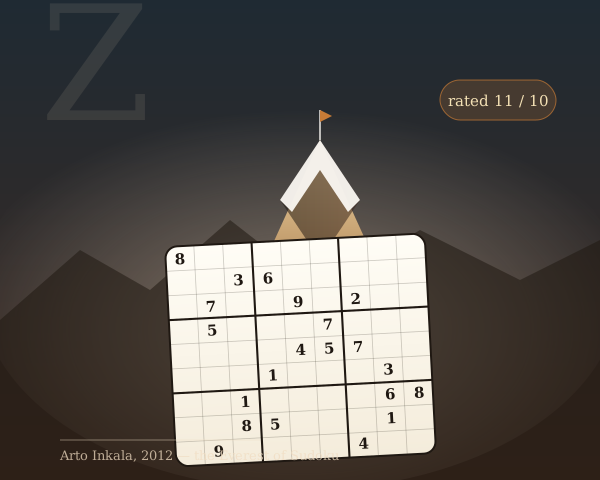
The board
Below is Arto Inkala's 2012 puzzle, exactly as he published it. 23 starting digits, one valid solution, and a difficulty depth that effectively no human will solve without computer assistance or hours of pencil-marking.
Who is Arto Inkala?
Arto Inkala is a Finnish mathematician with a PhD in applied mathematics. He has spent twenty years designing Sudoku puzzles that maximise logical depth rather than scarcity of givens. His first \"world's hardest\" puzzle, AI Escargot, was published in 2006; a successor followed in 2010, and the puzzle above in 2012. Each release was accompanied by a difficulty score on Inkala's own 1-to-11 scale — the 2012 puzzle was scored 11/11, which he claimed exceeded any previously rated puzzle on the same scale.
What makes this puzzle so hard?
Counter-intuitively, the Inkala 2012 puzzle is not minimally clued (it has 23 givens, well above the 17-clue minimum). What makes it hard is the logical depth required. A standard Hard puzzle can be solved with a handful of Hidden Singles and the occasional Naked Pair. The Inkala puzzle resists every standard technique — there are no Hidden Singles, no Naked Pairs, no Pointing Pairs, no Box-Line Reductions available on the opening move at all. Every step forward requires a Forcing Chain or Almost Locked Set, two techniques that ask you to follow contradictory hypothetical chains through several cells before placing a single digit.
In computer-solver terms, the puzzle has a maximum branching factor that exceeds anything a human can hold in working memory simultaneously. A constraint-propagation solver finishes it in under a millisecond; a human pencil-marker, with the right training, will typically take 4–6 hours.
The minimum-clue Sudoku
A separate but related curiosity is the proof that no Sudoku with fewer than 17 clues has a unique solution. In 2012 — the same year as the Inkala puzzle — Gary McGuire, Bastian Tugemann and Gilles Civario at University College Dublin published the result, after an exhaustive computer search that consumed roughly seven million CPU-hours on the Stokes cluster. The proof is final: no 16-clue Sudoku ever existed or ever will exist.
Note that 17-clue minimum and \"hardest ever\" are not the same property. Most 17-clue Sudoku puzzles are not especially hard to solve — they are sparse but their logical depth is small. The Inkala puzzle, with 23 clues, is much harder than the typical 17-clue board.
Is the Inkala puzzle solvable without guessing?
Yes — every well-formed Sudoku is solvable by pure deductive logic and the Inkala 2012 puzzle is well-formed. But the deductions are long. \"No guessing\" is a property of the puzzle, not of the human solver: a Forcing Chain looks like guessing to most players (\"if I put 5 in this cell, then 9 here, then contradiction in row 4\") but it is, formally, a deduction with a contradiction proof. Whether to count Forcing Chains as \"guessing\" is a matter of taste among Sudoku purists, and the argument is approximately as old as Sudoku itself.
Is there a Sudoku harder than Inkala's?
Probably. Gordon Royle's database at the University of Western Australia tracks Sudoku puzzles by their Sudoku Explainer (SE) rating — an automated difficulty score that goes well past 11. Several puzzles in Royle's collection score higher than the Inkala 2012 board. None of them, however, came with the press release, so \"hardest ever\" remains a partly journalistic title.
For practical purposes — a puzzle you can actually attempt — the Inkala 2012 board is the canonical answer. It is also, by reasonable measure, the most-attempted single Sudoku puzzle in the world.
Want a hard puzzle you can finish?
The Inkala puzzle is fascinating to look at but not pleasant to attempt — it is a research artefact more than a recreation. If you want a genuinely hard Sudoku that is still finishable in one sitting, try Zeloku's daily Expert puzzle. Expert is Zeloku's lowest-clue daily band, but its current label does not guarantee a named advanced technique or a fixed solve time. For the techniques themselves, see the Learn hub and the technique pages on X-Wing and Hidden Single.
FAQ
What is the hardest Sudoku puzzle ever made?
The most widely cited "hardest Sudoku ever" is the puzzle published by Finnish mathematician Arto Inkala in 2012. Inkala designed it explicitly to maximise the depth of logical chains required to solve it, and rated it at 11 on a 1-to-10 difficulty scale of his own design. It appears at the top of this page. Other strong candidates are Inkala's earlier 2010 puzzle and the AI Escargot puzzle from 2006, also by Inkala — he has effectively owned the "hardest ever" title for the past two decades.
What makes a Sudoku puzzle hard?
Sudoku difficulty has two ingredients: the number of givens (fewer is harder, with 17 being the proven minimum for a unique solution), and the depth of logical chains required to make progress. The Inkala puzzles famously give you 23 starting digits — more than the bare minimum — but every move requires forward-chaining through multiple advanced techniques (such as Forcing Chains, Almost Locked Sets, and Bowman's Bingo). A puzzle with 17 clues that solves via Naked and Hidden Singles is much easier than a puzzle with 25 clues that requires X-Cycles.
Can the hardest Sudoku be solved without guessing?
Yes — by definition. A well-formed Sudoku has exactly one solution and is solvable by pure deductive logic. The reason a human cannot "solve" Inkala's 2012 puzzle without effectively guessing is that the deductive chains are too long for human working memory to follow. Computer solvers using techniques such as Trial and Error, Forcing Chains, or full constraint-propagation can solve it in milliseconds without backtracking that exceeds the puzzle's logical depth.
How long does it take to solve the hardest Sudoku?
Inkala himself estimated his 2012 puzzle would take an expert human "days" — some reported solvers claim several hours of continuous work. A computer running an efficient constraint-propagation solver finishes it in under a millisecond. Most ordinary human solvers will not finish it at all without pencil-marking every cell and applying advanced techniques such as Forcing Chain.
What is the minimum number of clues a Sudoku can have?
17. In 2012, a team at University College Dublin (McGuire, Tugemann, Civario) proved by exhaustive computer search that no 16-clue Sudoku has a unique solution, and that valid 17-clue Sudoku puzzles do exist. This was a landmark proof — it took roughly seven million CPU-hours. Most published "minimum-clue" Sudoku puzzles use 17 clues; a 17-clue puzzle is not automatically harder than a 25-clue puzzle, only minimally constrained.
Are there harder Sudoku puzzles than Inkala's?
Probably yes, mathematically. Various researchers (including Royle's collection at UWA) maintain databases of puzzles whose Sudoku Explainer (SE) rating exceeds 11. Some of those puzzles score higher than Inkala's on automated difficulty scales. "Hardest ever" is a slightly slippery title — it depends on which scale you use and which solving techniques you allow. Inkala's puzzles remain the most-cited in popular press because they came with a clean media story and a designer with a Sudoku PhD.
Where can I play the hardest Sudoku puzzles?
On Zeloku, Expert is the lowest-clue daily band and uses an estimated complexity score; it is not certified by a required technique chain. Research-grade puzzles such as Inkala's are best approached as separate exhibits rather than compared directly with site labels.