Blog · Maths
How many Sudoku puzzles are there? a 22-digit answer
The number of valid Sudoku grids has been known exactly since 2005 — and it's bigger than the number of stars in the observable universe. Here's the real figure, where it comes from, and what it means for whether the puzzle can ever "run out."
Published 2026-07-27 · 7 min read
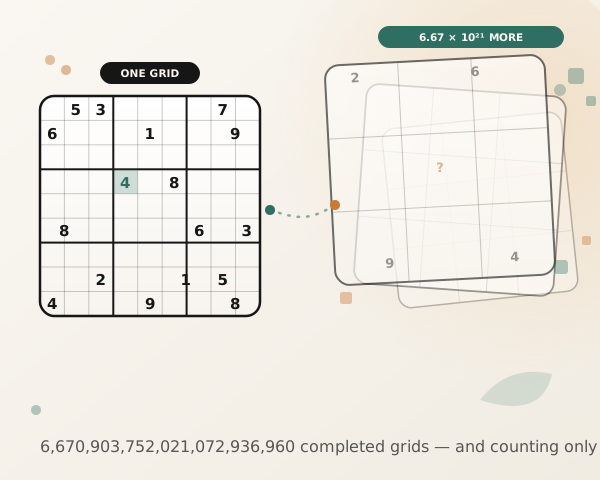
6.67 ×10²¹
completed grids
the full count
5.47 billion
essentially different
duplicates removed
17
minimum clues
proven in 2012
173 yrs
to publish them all
at one per second
Here's the exact number of valid, fully completed 9×9 Sudoku grids:
6,670,903,752,021,072,936,960
Read that as roughly 6.67 sextillion — a 6 followed by 21 digits. Astronomers estimate there are somewhere between 1022 and 1024 stars in the observable universe; the number of Sudoku grids sits right in that range. Every completed board you've ever solved is one instance drawn from a set roughly as large as the stars in the sky.
Where the number comes from
This isn't an estimate — it's an exact count, worked out in 2005 by two researchers, Bertram Felgenhauer and Frazer Jarvis. The trick that makes an otherwise impossibly large search tractable is to work on one "band" at a time (a Sudoku grid splits naturally into three horizontal bands of three boxes each), then use symmetry to avoid solving the same case twice. Here's the four-step pipeline that gets from one grid to the final count:
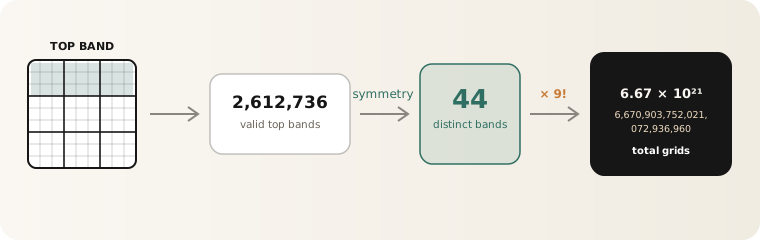
- Fix the top band. Relabel digits so the first block reads 1–9 in order — you can always do this without losing anything. There are 2,612,736 valid ways to fill in the rest of that top band alone.
- Collapse by symmetry. Swapping columns within a block, swapping whole blocks, swapping rows, and a few subtler digit-pair swaps all leave the number of ways to complete the grid unchanged. Chaining these equivalences collapses 2,612,736 candidates down to just 44 genuinely distinct bands.
- Brute-force the 44. A computer works out exactly how many full-grid completions each of those 44 bands has, and the results are summed.
- Multiply by 9!. Multiplying that sum by 362,880 (every way to relabel the digits back out of "standard form") gives the final total: 6,670,903,752,021,072,936,960.
The result has since been reproduced by other researchers using different methods, which is why it's treated as a settled fact rather than an estimate — Wikipedia's "Mathematics of Sudoku" article has the full derivation and citation trail if you want to check the working yourself.
The smaller, more honest number: 5.47 billion
6.67 sextillion overcounts what most people actually mean by "how many different Sudokus are there," because it treats grids that are obviously "the same puzzle" as distinct. Rotate a valid grid 90°, and it's still a valid grid — but it's not a new one in any useful sense. Swap every 3 for every 7 across the whole board, and the logic is identical; only the labels changed.
Two kinds of change don't affect the underlying logic at all:
- Relabelling the nine digits — 9! = 362,880 ways to swap digits for each other consistently across the whole board.
- Rearranging rows, columns, bands and stacks in ways that keep every row/column/box rule intact — 3,359,232 ways.
Combined, that's a group of 1,218,998,108,160 — about 1.22 trillion — "same puzzle in disguise" transformations. Divide 6.67 sextillion by that and you land almost exactly on 5,472,730,538 essentially different grids; mathematicians Ed Russell and Frazer Jarvis got the exact figure in 2006 by correcting for the small fraction of grids (about 0.005%) that have some self-symmetry, using a counting tool called Burnside's lemma. 5.47 billion is still comfortably more than the number of people alive on Earth — but it's the more meaningful number if what you actually want to know is "how many Sudokus exist that aren't secretly the same puzzle wearing a disguise."
Will Sudoku ever run out of new puzzles?
No, and it's not close. Take the conservative 5.47-billion figure — essentially different completed grids only, ignoring the even larger space of playable puzzles built from each one.
- One new grid published every second, day and night: about 173 years to get through all of them.
- One new grid published every day, the pace of a typical newspaper or daily app: about 15 million years.
In practice, no Sudoku site or newspaper enumerates the grid space at all — they generate a random valid grid on demand (usually through a backtracking algorithm, the same approach a computer uses to solve a Sudoku, run in reverse to build one) and then erase cells until a unique-solution puzzle remains. The 5.47-billion number matters less as a "days remaining" countdown and more as a sanity check: random generation won't meaningfully repeat itself for the foreseeable future of the puzzle's existence. That's the same guarantee behind Zeloku's daily board and the unlimited play mode — a fresh grid every time, drawn from a space too large to exhaust.
Why the number is so much bigger than a Rubik's Cube's
A standard 3×3×3 Rubik's Cube has about 43 quintillion (4.3 × 10¹⁹) possible configurations — already a number nobody can picture. A completed Sudoku grid has about 150 times more possible states than that, and both sit well below the estimated number of stars in the sky:
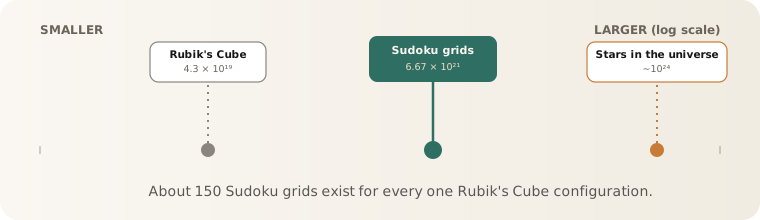
The reason is the same in both cases — a small set of local constraints (face colours that must match; digits that can't repeat in a row, column or box) still leaves an astronomical number of ways to satisfy them all simultaneously across a fairly small object. Constraint puzzles are deceptively compact to describe and deceptively vast to enumerate; that gap is most of why they're interesting to mathematicians at all, not just to puzzle solvers.
FAQ
- How many possible Sudoku puzzles are there?
- There are exactly 6,670,903,752,021,072,936,960 valid, fully completed 9×9 Sudoku grids — about 6.67 sextillion. That number counts finished grids, not puzzles (a puzzle is a grid with most cells erased), so the number of actual playable puzzles is vastly larger still.
- Who calculated the number of Sudoku grids?
- Bertram Felgenhauer and Frazer Jarvis computed the exact figure in 2005 by combinatorially analysing the possible arrangements of the first "band" of three boxes, then multiplying through the rest of the grid. Their result has since been independently confirmed by several other researchers using different methods.
- How many essentially different Sudoku grids are there?
- 5,472,730,538 — about 5.47 billion. This smaller number removes grids that are really "the same puzzle" in disguise: relabelling the digits 1–9 (362,880 ways) and rearranging rows/columns/bands/stacks in ways that preserve every rule (3,359,232 ways), a combined group of about 1.22 trillion equivalent transformations. Dividing the 6.67-sextillion figure by that group size lands almost exactly on 5,472,730,538, first computed precisely by Ed Russell and Frazer Jarvis in 2006.
- Will Sudoku ever run out of new puzzles?
- No — not in any meaningful sense. Even counting only the 5.47 billion essentially different grids, and even if a new website published a fresh one every second, it would take over 173 years to exhaust the list, before even considering how many different erasure patterns (playable puzzles) each grid supports. Practically, Sudoku puzzles are inexhaustible.
- Is a Sudoku puzzle the same as a Sudoku grid?
- No, and this is where people get the numbers confused. A grid is a fully completed 9×9 solution. A puzzle is a grid with cells erased down to a starting set of clues — typically 22 to 42, depending on difficulty (see our Sudoku difficulty levels guide) — that still has exactly one valid solution. Each completed grid can seed enormous numbers of distinct puzzles, since there are many different valid subsets of clues that pin down the same unique solution.
Keep reading
The proof that no puzzle needs fewer than 17 clues: the hardest Sudoku ever · why the puzzle never runs dry: unlimited Sudoku · where the grid and the name actually came from: the history of Sudoku · the fastest anyone has ever solved one: Sudoku world records.
Want to add one more grid to the 6.67 sextillion? Play today's Sudoku — freshly generated, never the same board twice.
Play a grid that's never existed before
- Blog
- Unlimited Sudoku
- Hardest Sudoku ever
- Play Sudoku
- Online Sudoku
- Sudoku puzzles
- Sudoku game
- Daily Sudoku
- Classic Sudoku
- Easy
- Medium
- Hard
- Expert
- Evil
- Extreme
- Mini Sudoku
- Kids Sudoku
- Beginner
- Solver
- Printable
- Sudoku PDF
- What is Sudoku?
- How to solve
- Strategies
- Techniques
- Variants
- No ads
- App
- Tips & tricks
- Get better
- Learn
- History of Sudoku
- Sudoku world records
- All pages